Measurable progress across emerging markets
Volatile geopolitics, shifting supply chains and sustainability pressure are reshaping how public funders, DFIs, embassies and impact investors structure emerging-market programmes in 2025.
Public and private partners rarely lack ambition; what is scarce is a delivery model that converts policy goals, funding commitments and investment theses into measurable outcomes on the ground.
Larive International’s Impact Report 2025 documents how 43 projects across Africa, Asia and Europe moved from strategy and programme design to measurable progress through four core delivery methods: market assessment, access to finance, market development and hands-on public-private partnerships (PPPs).
This article presents the key figures, sector themes, and insights from Larive’s 2025 impact work.
What is Larive International?
Larive International is a Netherlands-based international business development advisory firm established in 1975, focused on sustainable impact and private-sector development in emerging markets. The firm specialises in developing and implementing market entry and growth strategies in emerging markets across Asia, Sub-Saharan Africa, and Central and Eastern Europe.
Larive works with multinational corporations, niche SMEs and public organisations, including ministries, embassies, development partners and impact funds seeking practical delivery capacity.
The firm is active predominantly in three sectors that are central to many development portfolios: agri-food, automotive/mobility and renewable energy.
Their mission is to shorten the time, lower the costs, and reduce the risks associated with entering or expanding in emerging markets, while aligning commercial outcomes with broader development and impact objectives.
The Larive Group is a network of local consultancy partners in over 25 countries, each owned and managed by local entrepreneurs with deep roots, strong networks and a broad understanding of local business environments, providing a ready-made implementation platform for funders and investors.
What is the Impact Report 2025?
The Larive Impact Report 2025 is an annual review of projects, people and outcomes delivered during calendar year 2025, with a focus on what was concretely realised for companies, communities and public partners.
The report defines impact as delivering tangible solutions that serve as building blocks for local and international entrepreneurs, businesses, individuals and public partners, and contributing to outcomes that endure beyond the lifespan of a single project.
Larive frames its 2025 work as translating strategy into measurable progress, with outcomes described as partnerships activated, capabilities built, and solutions brought closer to scale along value chains.
The report attributes these outcomes to collaboration with the Larive Group partners and a wider network of companies and colleagues, explicitly combining local expertise with global best practices.
2025 Delivery summary | Projects, regions and delivery types
Total projects delivered in 2025
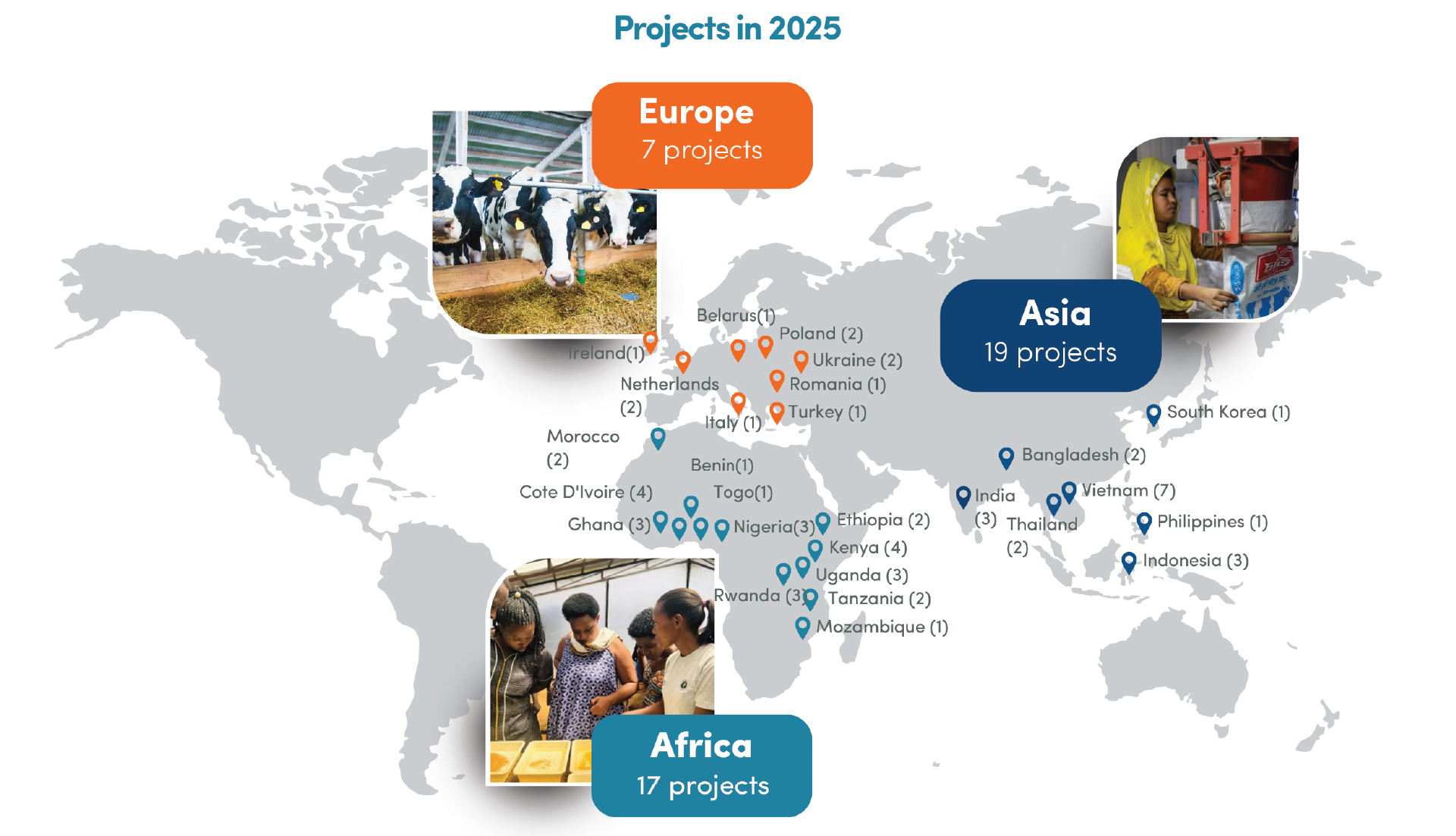
Larive International delivered 43 projects in 2025 across three regions:
- Africa: 17 projects
- Asia: 19 projects
- Europe: 7 projects
Geographic footprint | Where Larive worked in 2025
- Africa: Côte d’Ivoire, Ghana, Nigeria, Kenya, Uganda, Rwanda, Tanzania, Benin, Togo, Ethiopia, Mozambique
- Asia: Bangladesh, Vietnam, India, Indonesia, Thailand, Philippines, South Korea
- Europe: Poland, Ukraine, Romania, Turkey, Netherlands, Ireland, Italy, Morocco
This multi-country delivery shows the capacity to compare intervention and investment options and to operate with local nuance, instead of relying on one-size-fits-all programme replication.
Four core delivery types
Larive’s 2025 work is organised into four recurring intervention types that align well with typical donor, DFI and embassy instruments:
-
- Market assessment: Business intelligence, sectoral studies, market sizing, competitor analysis, regulatory and policy mapping
- Access to finance: Connecting entrepreneurs and companies with financiers, grant structuring and investment readiness support
- Market development: Value-chain strengthening, capability building, pilot deployment and scaling strategies
- Public-private partnerships (PPPs): Multi-stakeholder projects aligning corporate strategies with public policy and development goals
Key figures | Proof of execution | 2025 Outcomes by Region
Africa 2025 outcomes
- 5 market entries
- 763 people trained
- 32 jobs created
- 5 hardware deployed
- 10,600+ digital platform users (Samaki Poa aquaculture learning platform HowtodoAquaculture.com)
Asia 2025 outcomes
- 5 market entries
- 864 people trained
- 12 jobs created
- 8 hardware deployed
Europe 2025 outcomes
- 2 market entries
- 55 M&A targets assessed
- 257 private-sector interviews
- 6 market assessments
Combined 2025 metrics
- Total projects: 43 (17 Africa + 19 Asia + 7 Europe)
- Total people trained: 1,627 (763 Africa + 864 Asia)
- Total market entries: 12 (5 Africa + 5 Asia + 2 Europe)
- Total jobs created: 44 (32 Africa + 12 Asia)
These metrics demonstrate a balanced ‘build + enable’ model: build capability through training, enable adoption through hardware and digital tools, and enable better decisions through market intelligence and M&A screening that de-risk capital deployment.
Impact by sector | Agri-food, energy and adjacent value chains
Agri-food sectors | 2025 project count
- Aquaculture: 11 projects
- Poultry: 3 projects
- Cocoa: 5 projects
- Animal feed: 4 projects
- Agriculture: 4 projects
- Horticulture: 3 projects
- Alternative proteins: 3 projects
- Dairy: 1 project
Energy, industry and other sectors | 2025 project count
- Renewable energy: 3 projects
- Industry and manufacturing: 4 projects
- E-waste: 1 project
- FMCG: 1 project
For agri-food funders and leaders, the report demonstrates repeated emphasis on protein value chains (aquaculture, poultry, shrimp) and value-chain resilience through skills, technology adoption and market collaboration.
For energy, climate and mobility portfolios, it shows how infrastructure and energy reliability constraints can be addressed through scalable clean-energy solutions and investment-ready market linkages with a clear commercial logic.
Five impact messages | What you should remember
- Impact at scale requires a portfolio model, not one-off projects
-
- Data point: 2025 delivery spans 17 projects in Africa, 19 in Asia and 7 in Europe (43 total projects).
- Interpretation: This indicates the capability to run multiple concurrent interventions across markets, sectors and stakeholder types, which is essential for portfolio-wide impact rather than isolated pilots.
- Skills development is a primary scaling lever in agri-food and energy transitions
-
- Data point: 763 people trained in Africa and 864 people trained in Asia in 2025 (1,627 total).
- Interpretation: Training outcomes reduce operational risk for new technologies and operating models, especially in value chains that rely on consistent technical execution, such as aquaculture, poultry, cold chains and renewable energy.
- Tangible economic outcomes are delivered alongside learning and pilots
-
- Data point: Africa reports 5 market entries and 32 jobs created; Asia reports 5 market entries and 12 jobs created.
- Interpretation: Impact is framed not only as activity (studies, workshops) but also as market activation (entries), local employment effects and investable propositions along priority value chains.
- Digital adoption plus on-the-ground delivery can accelerate capability across entire value chains
-
- Data point: Samaki Poa moved from platform development to real sector impact, surpassing 10,600+ users.
- Interpretation: A blended model combining digital learning tools with field-level support can accelerate adoption and standardisation across fragmented value chains.
- Impact is often created by enabling better investment decisions
-
- Data point: Europe reports 55 M&A targets assessed, 257 private-sector interviews and 6 market assessments (plus 2 market entries).
- Interpretation: Impact frequently takes the form of reduced uncertainty and improved capital allocation in complex entry environments, where robust decision support is as valuable as direct implementation.
Impact Themes That Show Up Across Sectors
Capability building as the scaling engine
- A recurring pattern in the report is that training is treated as a core output, not a peripheral add-on.
- With 763 people trained in Africa and 864 in Asia (1,627 total), Larive positions human capability as a prerequisite for sustainable agri-food productivity, food safety and clean-energy system reliability.
Public-private partnerships (PPPs) as a delivery platform
- The report repeatedly points to public-private collaboration as a way to mobilise stakeholders, finance and implementation capacity.
- This matches Larive’s strength in aligning corporate strategies with public policy goals and delivering complex multi-stakeholder projects with consistent project management, reporting and compliance.
Digital plus field delivery for faster adoption
- In East Africa, the Samaki Poa initiative is explicitly described as moving beyond platform development to real sector impact, surpassing 10,600+ users across the aquaculture value chain.
- The underlying funder takeaway is that blended models, digital learning supported by on-the-ground execution, can accelerate the adoption of good practices across fragmented value chains.
Decarbonisation and reliability as a business and development opportunity
- The RenewableTechNigeria case accelerated the adoption of solar-hybrid solutions, reducing reliance on diesel and building local technical capacity through Dutch-Nigerian collaboration.
- This ties clean energy to operational resilience and cost reduction, often the decisive factors in emerging-market operating models where grid reliability varies and climate and energy-access goals converge.
Investment readiness in value chains like cocoa
- CocoaTechD’Ivoire progressed on a business case, investor readiness, field activities and international engagement, laying foundations for sustainable impact in a strategic export sector.
- This signals that de-risking is more than technical or operational; it is also financial and institutional, requiring credible structures and investable models that can crowd in private capital.
What this means for private and public organisations
For agri-food organisations
- The strongest signal for agri-food portfolios is that protein value chains (aquaculture, poultry, shrimp) scale when skills, technology and market structures are improved together rather than in isolation.
- Programmes that pair technical assistance and training with concrete market access and investment-readiness work tend to generate more durable productivity and income gains.
For energy and climate companies
- Clean-energy adoption accelerates when solutions reduce operational pain points such as diesel dependence and uptime risk, while local technical capacity is built to install, operate and maintain systems.
- Linking climate objectives to reliability and cost outcomes increases uptake among commercial users and makes blended finance structures more effective.
For mobility and industrial institutions
- The decision-enabling outputs (interviews, assessments, M&A screening) highlight the importance of robust local validation before committing capex and organisational attention.
- For DFIs, impact funds, as well as private players, such groundwork can significantly improve the risk-return profile of investments in complex or fast-changing markets.
The 2025 outcomes suggest a clear operating thesis: emerging-market growth and impact are unlocked by combining strategy with local execution capacity and partner alignment. Larive’s model, market intelligence, strategy development, implementation support and PPP delivery, maps closely to the needs of public and private investors whose internal teams cannot sustainably cover 20+ markets with sufficient depth.
Frequently Asked Questions (FAQ)
What is the Larive Impact Report 2025?
The Larive Impact Report 2025 is Larive International’s annual overview of projects, people and outcomes delivered in 2025, framing impact as tangible solutions that endure beyond a single project and are achieved through collaboration between local expertise and global best practices.
How many projects did Larive deliver in 2025?
Larive delivered 43 projects in 2025: 17 projects in Africa, 19 projects in Asia and 7 projects in Europe.
What regions did Larive work in during 2025?
Larive worked in Africa (including Côte d’Ivoire, Ghana, Nigeria, Kenya, Uganda, Rwanda, Tanzania, Benin, Togo, Ethiopia, Mozambique), Asia (including Bangladesh, Vietnam, India, Indonesia, Thailand, Philippines, South Korea) and Europe (including Poland, Ukraine, Romania, Turkey, plus EU and EEA linkages).
What measurable outcomes are reported in the Impact Report 2025?
Key outcomes include 1,627 people trained (763 in Africa; 864 in Asia), 44 jobs created (32 in Africa; 12 in Asia), 12 market entries (5 in Africa; 5 in Asia; 2 in Europe), 10,600+ digital platform users (Samaki Poa), 55 M&A targets assessed and 257 private-sector interviews (Europe).
How does Larive define impact?
Larive defines impact as tangible solutions that endure beyond a single project and are achieved through collaboration between local expertise and global best practices, leading to measurable improvements for businesses, individuals and public partners.
How does Larive support market entry and private-sector development in emerging markets?
Larive’s mission is to shorten time, lower costs and reduce risks of entering or expanding in emerging markets through business intelligence, strategy development, implementation support and PPP delivery, often embedded in donor or DFI-backed programmes.
What are the four core delivery types Larive uses?
The four recurring intervention types are: (1) market assessment, (2) access to finance, (3) market development and (4) hands-on public-private partnerships (PPPs).
What sectors does Larive focus on?
Larive focuses predominantly on agri-food (aquaculture, poultry, cocoa, animal feed, agriculture, horticulture, alternative proteins, dairy), renewable energy, industry and manufacturing, e-waste and FMCG.
About Larive International
Larive International is a Netherlands-based international business development advisory firm established in 1975.
The firm specialises in market entry and growth strategies in emerging markets across Asia, Sub-Saharan Africa and Central and Eastern Europe. With over 300 strategic business development experts across 25+ countries (via the Larive Group network), Larive supports multinational corporations, niche SMEs and public organisations, amongst others in agri-food, mobility and automotive, and renewable energy sectors.
Contact:
Larive International B.V.
Sparrenheuvel 10
3708 JE Zeist
The Netherlands
Tel: +31 30 6933221
Website: www.larive.com
Published: January 2026
Document source: Larive International Impact Report 2025