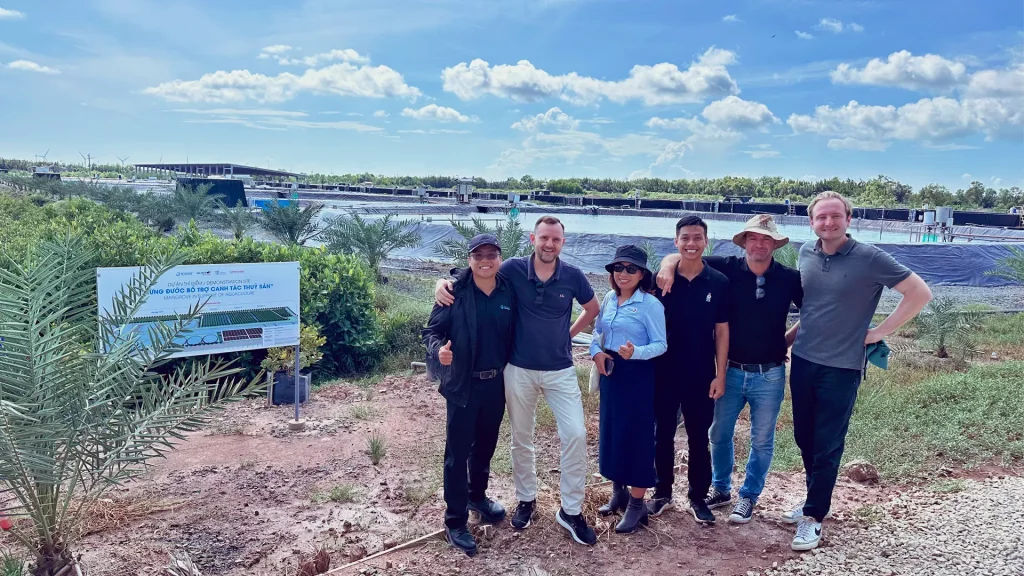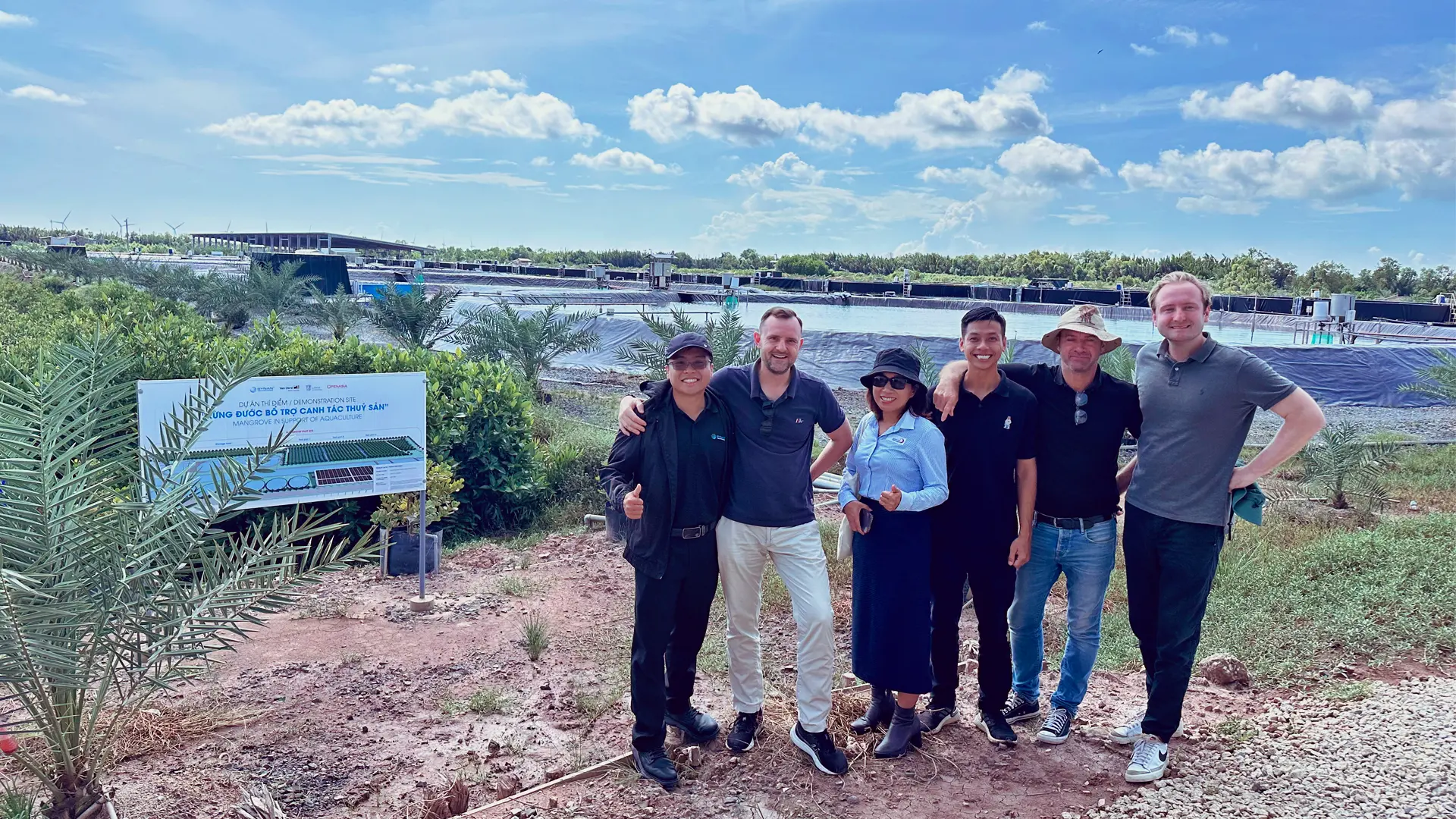
TOMGOXY® Zero is an initiative Larive International originated and has coordinated from the outset in Trà Vinh, Vietnam. By bringing together the right partners, securing co-funding, and delivering the preparatory work that made the demonstration phase possible. The project embeds restoration directly into food production, rigorously testing how mangroves can filter effluent, enhance biodiversity, and contribute to carbon sequestration while maintaining farm productivity. It does so against a backdrop of real urgency: the Mekong Delta has lost approximately 83,000 hectares of mangrove since 1973, with shrimp aquaculture expansion accounting for roughly 2,150 hectares of ongoing loss per year.
This approach positions the consortium as a frontrunner in sustainable aquaculture innovation, offering a model that simultaneously addresses climate resilience, ecosystem recovery, and inclusive economic development in one of the world’s most strategically important emerging aquaculture markets.
The demonstration pilot
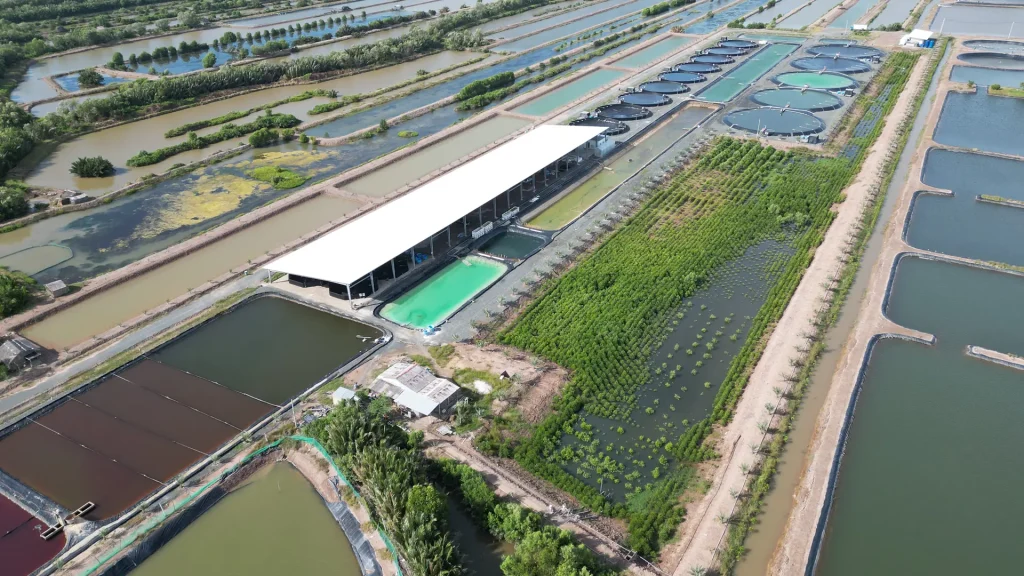
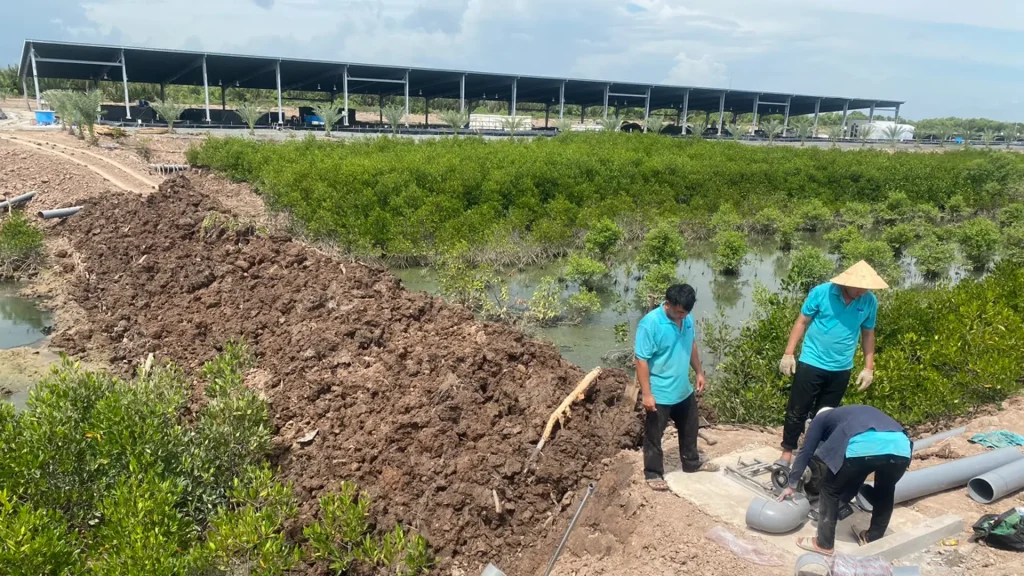
Building on groundwork and earlier trials, the demonstration pilot ran from September 2024 to April 2026 at RYNAN’s Salicornia farm in Trà Vinh, Vietnam. At the heart of the setup is a 1.2-hectare constructed mangrove wetland, hydraulically integrated with RYNAN’s TOMGOXY® super-intensive shrimp production loop, itself operating across 15 ponds totalling 1.0 ha (5 × 0.10 ha and 10 × 0.05 ha). The site was divided into separate zones for filtration, production, and mangrove restoration, with a nearby natural mangrove stand sampled under the same protocol as an undisturbed baseline control.
The trial design tested three hydraulic retention times (HRTs), 0.5/1 day, 3 days, and 5 days, across three plots and three rounds of trials with intermittent dry periods, closely mimicking real production cycles.
What the data showed
Five key findings emerged from the pilot:
- HRT is the master variable. Across both nitrogen and phosphorus, removal efficiency was overwhelmingly explained by how long water sat in the wetland, outranking plot, season, and trial round as a driver of performance.
- Three days is the operational sweet spot. Nutrient removal climbed sharply up to a 3-day retention time; extending to 5 days yielded no significant additional gain. This means operators can size and schedule around a 3-day HRT as the reliable default, without tying up wetland capacity unnecessarily.
- Young trees require adaptive management. Mangrove seedlings tolerate shorter retention times better during establishment. The protocol that emerged: short HRTs early on, transitioning to 3-day cycles in mature stands, with topography-aware planting to keep young trees out of low-lying, flood-prone zones.
- Substrate drives performance as much as design. The site’s fine-textured sandy silt loam retains nutrients in the top soil layers, exactly where mangrove roots and soil microbes are most active. Substrate quality is now a screening criterion before any site design begins.
- Over 95% of the carbon stock sits in the soil, not the trees. This single finding transforms the project’s value proposition: a constructed mangrove wetland embedded in a working shrimp farm is not just an effluent treatment system, it is a credible, measurable asset for blue carbon finance and a building block toward net-neutral aquaculture.
Three compliance regimes, one piece of infrastructure
The results demonstrate that a single mangrove wetland integration simultaneously addresses:
- Effluent compliance, demonstrated total nitrogen (TN) and total phosphorus (TP) removal under operational HRT conditions, providing a pathway to meet Vietnam’s tightening national discharge standards without costly closed-loop retrofits.
- Biodiversity obligations, aligning with Vietnam’s National Biodiversity Strategy to 2030 and the habitat restoration expectations of ASC and BAP certification schemes.
- Climate credibility, soil-dominated carbon stocks support project-level carbon finance and a verifiable path toward net-neutral aquaculture.
Scaling up
In 2026, Larive and RYNAN are jointly advancing the project into its scaled pilot phase, expanding to a new site in Sóc Trăng with an increased number of ponds and mangrove zones. This phase will test the system under varying environmental and operational conditions to generate the data needed to prepare the model for broader implementation, including on private land and within large-scale coastal infrastructure projects. Larive’s role going forward is explicitly commercial: taking a field-validated design and deploying it across the Southeast Asian shrimp belt, with priority geographies including Vietnam, Indonesia, Thailand, India, and Bangladesh.
Questions about this project, or interested in exploring collaboration? Please get in touch with our colleague Rogier Becker.