Two small countries, one big opportunity
There is something quietly remarkable about the relationship between Bangladesh and the Netherlands. Two small, densely populated, delta nations, both deeply shaped by water, both reliant on international trade, both punching well above their weight on the global stage. One is the world’s second-largest agricultural exporter; the other, the world’s second-largest ready-made garments exporter. The symmetry is not coincidental. It is the foundation of a partnership that is growing more commercially compelling by the year.
For decades, Dutch engagement in Bangladesh was rooted in development cooperation, particularly in water management and climate resilience. That era is not over, but it is being overtaken by something bigger. Trade, foreign direct investment, and a shared policy vocabulary around sustainability are reshaping the relationship. And as Bangladesh navigates one of the most consequential transitions in its modern history, the Netherlands is uniquely positioned to support and mutually benefit from what comes next.
Three converging realities
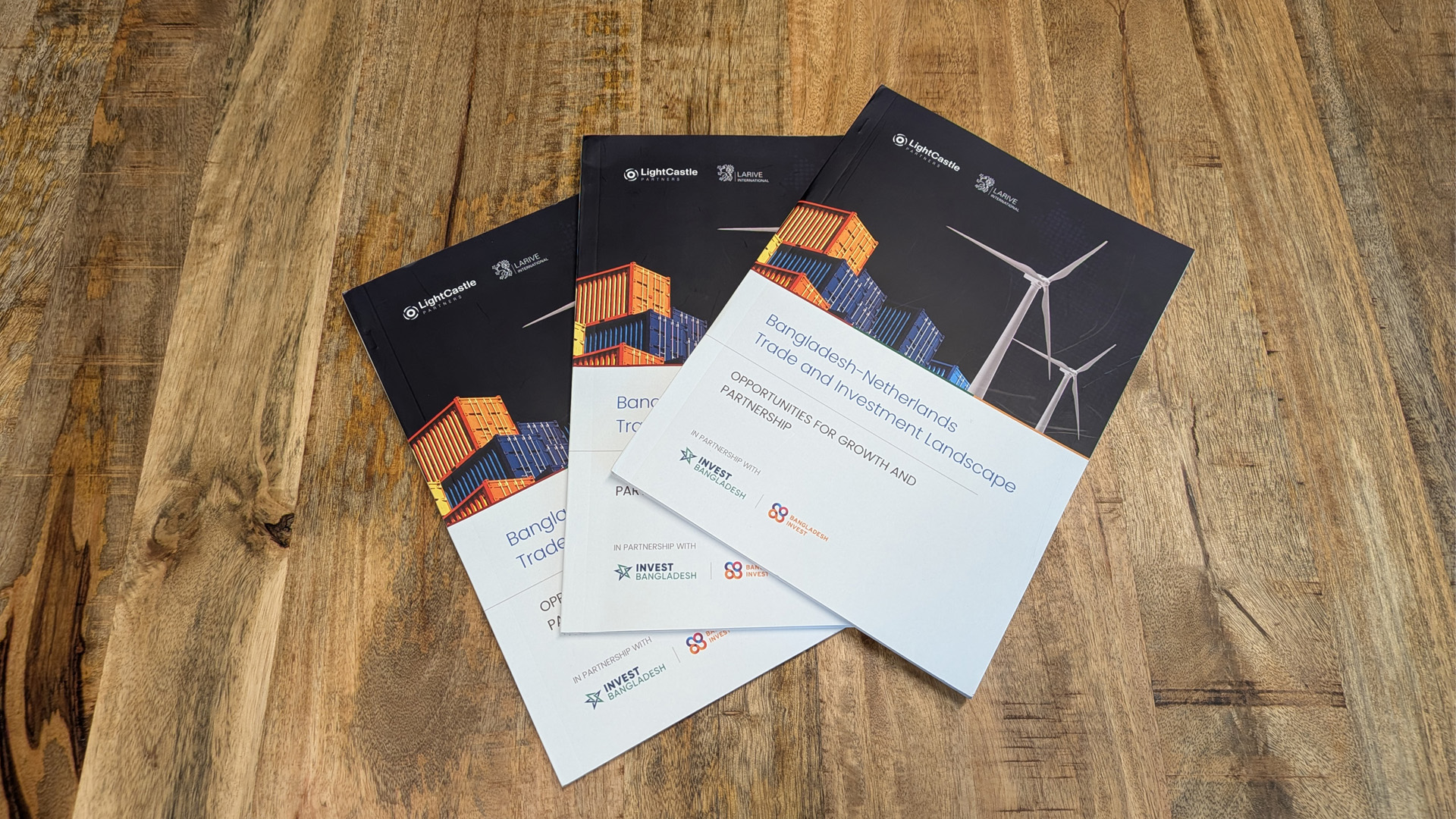
The 2026 Bangladesh–Netherlands Investment Landscape whitepaper, produced jointly by LightCastle Partners and yours truly, builds its investment case on three structural arguments.
- First: policy and strategic alignment. Bangladesh is progressively embedding environmental standards, export compliance, and green transition priorities into its national development agenda as it moves toward graduation from Least Developed Country (LDC) status. This aligns directly with the Netherlands’ longstanding leadership in sustainable development, circular economy approaches, and high regulatory standards. Two countries, two agendas, one direction.
- Second: a structural shift in Bangladesh’s growth model. Bangladesh is no longer content to compete on cost alone. The country is actively pursuing export diversification and higher-value industrial development, moving beyond its dependence on a narrow set of traditional sectors. The Netherlands’ strengths in agri-food systems, logistics, energy transition, and circular industries are more than relevant to this shift as they are precisely what Bangladesh needs to navigate it.
- Third: Bangladesh enters this transition from a position of real strength. Between 2013 and 2023, its GDP grew at an average of 6.4% per year, one of the most consistent trajectories in emerging Asia. A demographic dividend extending to the mid-2030s, a middle-class population of 34 million, and a strategic location at the apex of the Bay of Bengal give Bangladesh scale and momentum that few frontier markets can match. The policy environment is increasingly open, with 100% FDI permitted in most sectors and tax incentives of up to ten years in priority economic zones.
Eight sectors worth knowing
Within this broader partnership, eight priority sectors stand out as immediately actionable for Dutch companies.
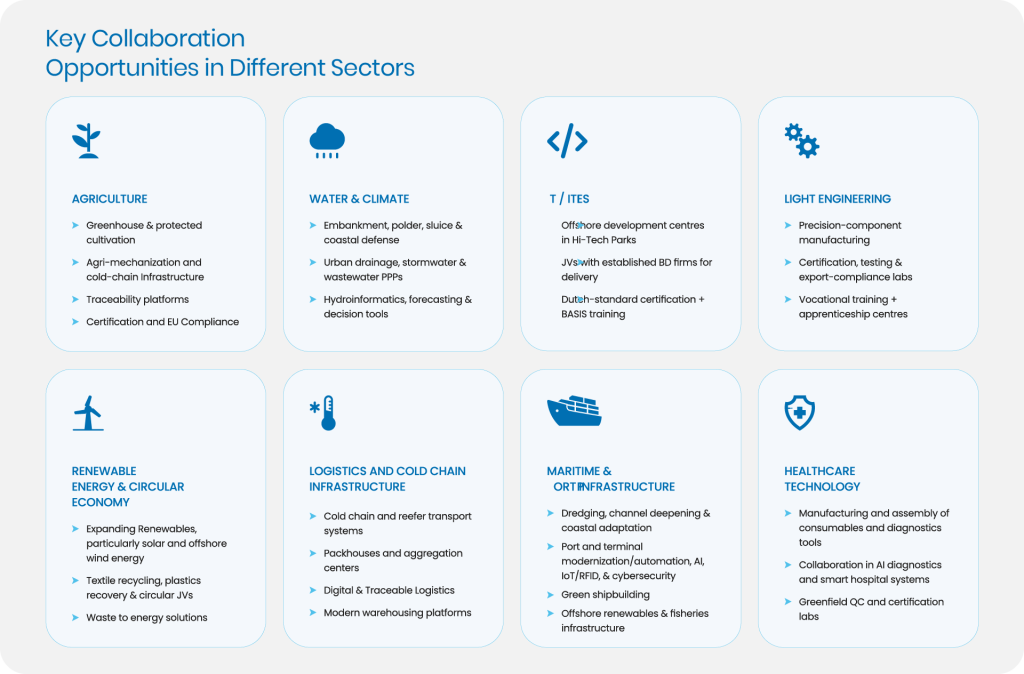
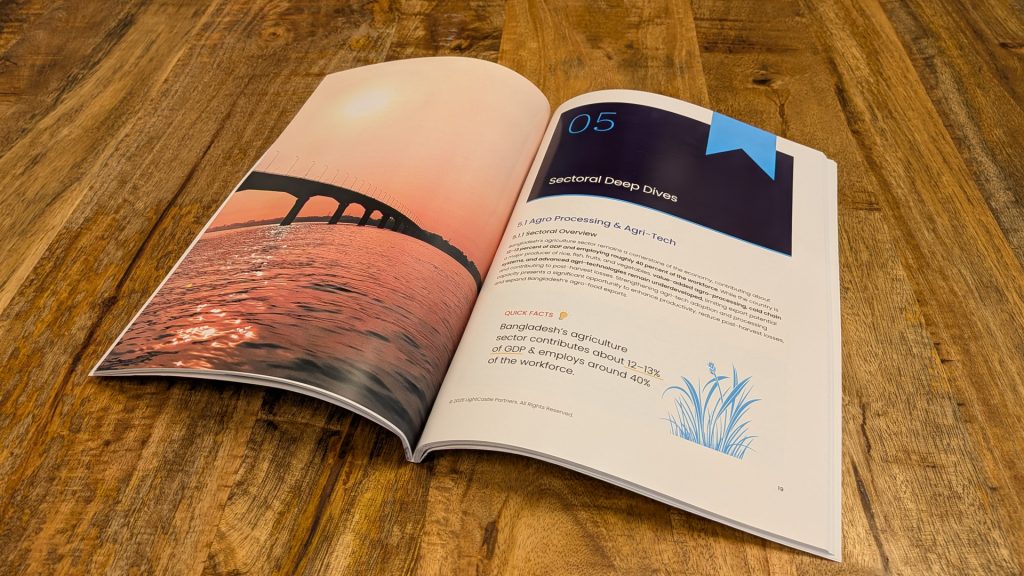
- Agro processing & agri-tech. Bangladesh’s agriculture sector employs roughly 40% of the workforce, yet only 10–12% of agricultural output undergoes formal processing. Post-harvest losses of 20–30% in fruits and vegetables represent both a problem and an opportunity. Dutch expertise in greenhouse systems, precision agriculture, cold-chain logistics, and food safety is a near-perfect match.
- Water & climate resilience. Around 70% of Bangladesh’s land sits less than five metres above sea level. The Bangladesh Delta Plan 2100, co-developed with a Dutch-led consortium, has created a USD 37 billion infrastructure investment pipeline. With over 1,000 years of flood management experience and a water sector generating €12 billion in annual exports, the Netherlands is the natural partner here.
- Logistics & cold chain. Bangladesh ranked 88th out of 139 countries on the World Bank’s Logistics Performance Index. Yet its freight and logistics market is estimated at USD 32 billion, and the Matarbari Deep Sea Port is expected to be operational by 2029–2030, dramatically reshaping regional connectivity. Dutch expertise, Rotterdam ranked 3rd globally on the same index, is directly transferable.
- Renewable energy & circular economy. Renewables account for just 5% of Bangladesh’s energy mix today, but a national target of 20% by 2030 is backed by growing policy and investment momentum. The garment sector alone generates approximately 400,000 tonnes of pre-consumer textile waste annually, a commercially significant circularity opportunity that maps directly onto Dutch expertise in textile recovery and resource efficiency.
- Healthcare technology. As with India, Bangladesh imports 85–90% of its medical devices, while a growing middle class, a diabetes epidemic, and an ageing population are rapidly expanding demand. The Netherlands ranks sixth globally as a medical technology hub, home to companies like Philips, and is well-placed to help build local manufacturing and diagnostic capacity.
- Maritime & port infrastructure. Bangladesh’s ports handle over 90% of its international trade. Dredging, terminal operations, digital port solutions, and blue economy development are all areas where Dutch companies, including global dredging leaders Boskalis and Van Oord, have demonstrated world-class capability.
- Light engineering. The sector has expanded at a CAGR of 10.35% between 2013 and 2024, supplying machinery, spare parts, and components to Bangladesh’s key industries. Technology transfer, CNC machining, and quality assurance partnerships with Dutch precision engineering firms offer clear collaboration potential.
- IT/ITeS. Bangladesh’s IT and IT-enabled services exports have grown at around 20% CAGR over the past four years. With 21% of Dutch companies struggling to fill key IT positions, Bangladesh’s pool of 300,000+ professionals, available at competitive cost, is an increasingly attractive offshore development option.
The moment to move
The convergence of policy alignment, structural transformation, and macroeconomic momentum makes Bangladesh one of the most compelling emerging market opportunities available to Dutch businesses right now. What this whitepaper makes clear is that the question is how and with whom.
Larive International and LightCastle Partners have spent years building exactly that bridge. If you’re a Dutch business weighing your next move in Bangladesh, the people to speak to are Laura and Rogier at Larive. They know the market, they know the partners, and they know how to help you move from interest to action with confidence. Reach out via larive.com to start the conversation.
FAQ
What makes Bangladesh an attractive investment destination for Dutch companies in 2026?
Bangladesh offers a USD 456 billion economy growing at nearly double the global average, a 34-million-strong middle class, 100% FDI permitted in most sectors, and deep structural complementarity with Dutch industrial strengths in agri-food, water, logistics, and energy.
What are the eight priority sectors for Dutch investment in Bangladesh?
The eight sectors identified in the whitepaper are: Agro Processing & Agri-Tech, Water & Climate Resilience, Logistics & Cold Chain, Renewable Energy & Circular Economy, Healthcare Technology, Maritime & Port Infrastructure, Light Engineering, and IT/ITeS.
How significant is the Netherlands as an investor in Bangladesh?
The Netherlands became the third-largest FDI stockholder in Bangladesh as of FY25, reflecting a 38.9% year-on-year rebound, and remains one of Bangladesh’s top five EU export destinations.
What is LDC graduation and why does it matter for investors?
LDC (Least Developed Country) graduation is a UN milestone signalling economic maturity. As Bangladesh approaches this transition, it must diversify beyond cost-based competitiveness, creating new demand for Dutch technology, know-how, and sustainable business models.
How can Larive International support Dutch companies entering Bangladesh?
Larive International, together with its exclusive Bangladesh partner LightCastle Partners, offers end-to-end market entry support: business intelligence, partner identification, strategy development, public-private partnerships, and post-investment support. Contact larive.com to speak with Laura or Rogier directly.