
Kenya has a reputation among international companies: English-speaking, internationally connected, the obvious first stop in East Africa, and therefore “easy” to enter. That reputation is partly earned and partly a trap. The accessibility is real. Simplicity is not the same thing.
A serious economy, and a strategic one
Kenya is the largest economy in East Africa, with a GDP of roughly $120 billion in 2024 and a services sector that makes up around 60% of output. A nation of 54 million people, it is where Indian Ocean trade meets the Sub-Saharan interior, and Nairobi has become the region’s commercial and diplomatic capital. The World Bank projects GDP growth of 4.7% in 2026, holding in the 4.7–5.0% range over the medium term. As a founding member of the East African Community and IGAD, Kenya carries influence well beyond its borders, and with about 90% of its energy drawn from renewables it is positioning itself at the front of Africa’s green and digital transitions.
That strength sits alongside real structural complexity, which is exactly why preparation beats assumption here.

Africa is not a country
This is where the most expensive mistakes begin. In his book Africa Is Not a Country, Dipo Faloyin dismantles the lazy habit of treating a continent of dozens of nations as one interchangeable market. The same error shows up in boardrooms: a strategy that worked in one country is copy-pasted into the next; a large population is read as automatic demand; signing a distributor is mistaken for “market entry, solved.” Each market has its own logic, purchasing power, distribution realities, trust networks, and rhythms. Kenya is no exception. It is genuinely open and commercially dynamic, but openness rewards the companies that diligently do the local work.
Doing business in Kenya: accessible does not mean simple
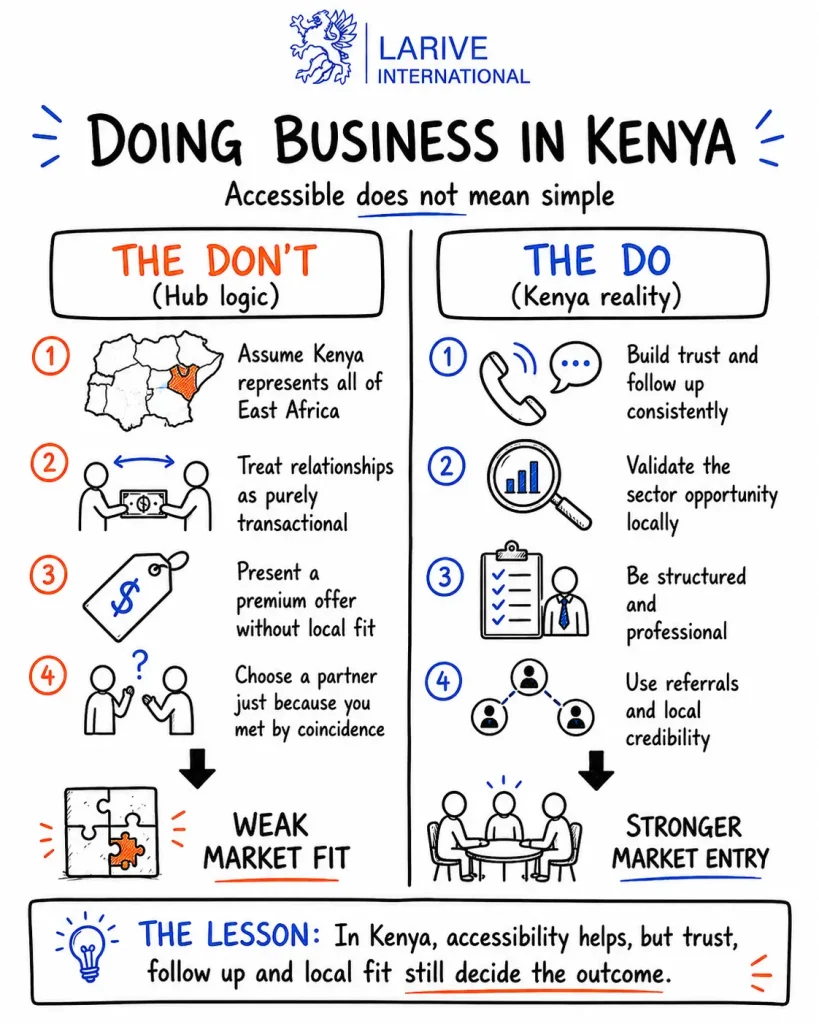
Do
- Use Kenya as a strategic entry point, but validate the specific sector opportunity.
- Invest in trust, consistency and professional, structured follow-up.
- Learn how sector networks, associations and development partners shape the market.
- Adapt to local price sensitivity and financing realities.
- Combine formal meetings with informal relationship-building.
- Look beyond Nairobi when the opportunity warrants it.
Don’t
- Assume Kenya automatically represents East Africa.
- Treat relationships as transactional, or let momentum drop after a good first meeting.
- Assume the private sector operates separately from the wider ecosystem.
- Lead with a premium solution and no clear business case.
- Approach the market cold, without local credibility.
- Equate Nairobi with the full Kenyan market.
The local partner who knows: Lattice
Navigating these blurred lines is far easier with someone who lives them. In Kenya, Larive’s partner is Lattice, a Nairobi-based advisory and implementation firm covering East Africa, and Larive International’s named regional partner. Over more than sixteen years its work has touched some of Kenya’s largest companies and most compelling growth stories.
Lattice is unusual in that it both designs strategy and executes on the ground. Lattice Consulting handles corporate finance, market entry and capacity building; Lattice Aqua runs hands-on aquaculture programming, including the Aquaculture Academy it launched in 2021 to train “Aquapreneurs” across the value chain. Its leadership pairs international credentials with local grounding: founder and CEO Winnie Ouko holds an MBA from Cornell, and director Joe Maye brings over fifteen years in financial services across Canada, the US and Kenya. The firm sits at the centre of a dense network, funders, banks and SACCOs, county governments, TVET institutions and the apex private-sector body KEPSA, with delivery across Kenya, Uganda, Rwanda, Burundi, Tanzania, the DRC and South Africa.
A fun fact: the name is the strategy. A lattice is stronger as an interwoven grid than any single strand, exactly how the firm cross-weaves corporate advisory, training and aquaculture, three disciplines most firms keep apart.
The pace of opportunity here is easy to underestimate. A decade ago, cage fish farming did not exist on Lake Victoria. Today, more than 4,000 cages are registered, with nearly 3,000 fish farmers in Homa Bay, Siaya and Kisumu counties alone. The real mistake companies make is rarely cultural ignorance alone. It is strategic oversimplification. Kenya hakuna matata, but only with the right local setup. Reach out to our colleague Claudy to start your journey!

Frequently asked questions
Is Kenya a good market for international companies to enter? Kenya is East Africa’s largest economy (around $120 billion GDP in 2024), with services at roughly 60% of output and projected growth of 4.7% in 2026. It is open and well-connected, but successful entry depends on validating the specific sector opportunity and building local credibility; accessibility is not the same as simplicity.
Does Kenya represent the wider East African market? No. Kenya can be an effective entry point and regional hub, but it is not a substitute for country-specific validation. Each East African market has its own purchasing power, distribution and business culture.
Why do companies need a local partner to enter Kenya? Decisions in Kenya often move through a mix of formal and informal channels, and the private sector operates within a wider ecosystem of associations, government bodies and development partners. A credible local partner provides the networks, trust and on-the-ground execution that cold entry lacks.
Who is Lattice? Lattice is a Nairobi-based advisory and implementation firm covering East Africa and Larive International’s named regional partner. It combines corporate finance and market-entry strategy (Lattice Consulting) with hands-on aquaculture programming (Lattice Aqua).
How does Larive help companies enter and grow in Kenya? Larive International develops and implements market-entry and growth strategies in emerging markets, working with deeply embedded local partners such as Lattice to combine international advisory experience with local execution. Explore Larive’s East Africa work in FoodTechAfrica and Samaki Poa, or get in touch.