
There is no such place as “the African market.” There are dozens of countries, each with its own logic, pace and opportunities, yet plenty of expansion plans still arrive with a single “Africa strategy” tucked under one arm. The continent tends to reward the companies that notice the difference.
Few places make that case like Nigeria. Often shorthanded as “an oil economy with a difficult reputation,” it is quietly powered by something broader: recent growth has been carried by services and agriculture as much as by recovering oil production, reaching 3.9% year-on-year in the first half of 2025, up from 3.5% a year earlier.
The scale is hard to ignore. With around 233 million people, Nigeria is Africa’s most populous nation and is projected to become the world’s third-largest by 2050. On a GDP of roughly $252 billion in 2024, it ranks among Africa’s two largest economies, and the IMF places it among the top six contributors to global real GDP growth in 2026, ahead of economies such as Germany and Brazil.
None of this erases the pressures. The World Bank’s October 2025 Nigeria Development Update is candid that reform gains have yet to reach most households. But for companies thinking in decades rather than quarters, the direction of travel is what matters.

Africa is not a country
As the writer Dipo Faloyin argues in Africa Is Not a Country, the continent’s nations carry their own histories, rhythms and rules; there is no single “African strategy” to copy and paste. Nigeria itself is often described as a continent within a country, with hundreds of ethnic groups and languages, and business environments in Lagos, Abuja and the regions that are not interchangeable.
That is where the familiar misconceptions live. A large population is read as easy demand, when demand really depends on purchasing power, distribution and trust. A signed distributor is mistaken for “market entry solved,” when partner selection is only the starting line.
A short field guide for Nigeria
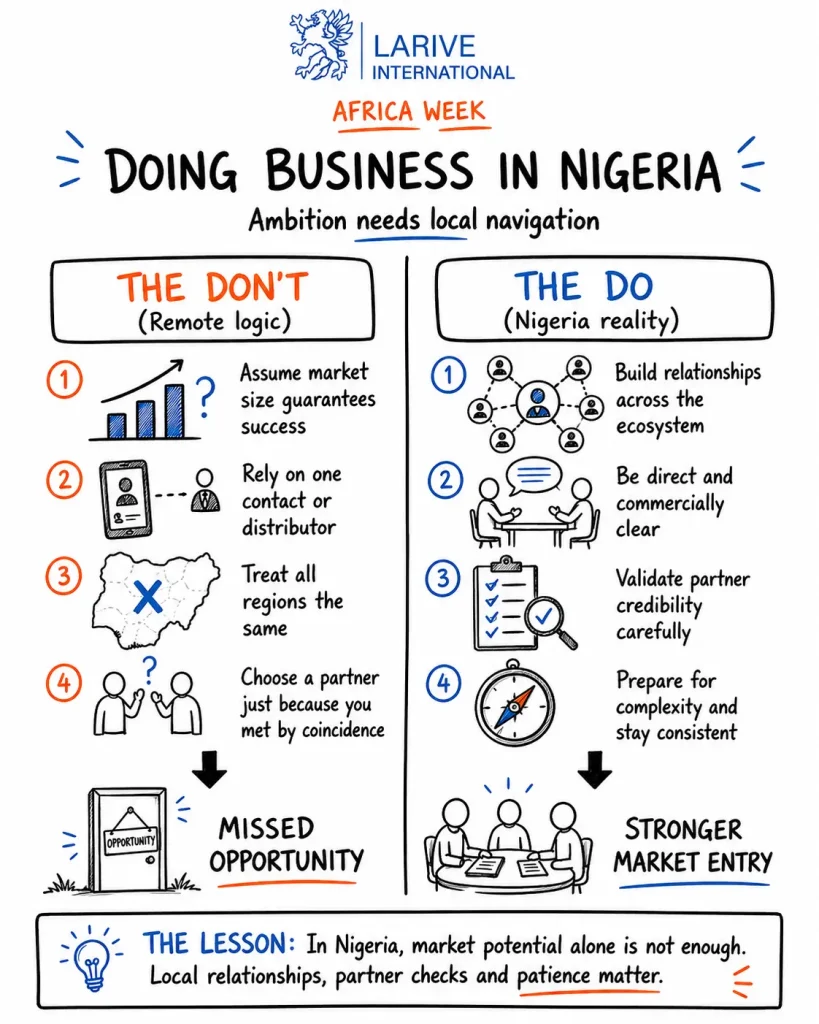
Do
- Take the market seriously and prepare for complexity.
- Build relationships across business, sector and institutional networks.
- Be direct, commercially clear and opportunity-driven.
- Check partner credibility carefully.
- Understand regional differences within the country.
- Plan around logistics, payments and regulation.
- Show resilience and consistency.
- Use local expertise to negotiate and navigate.
Don’t
- Assume size alone guarantees success.
- Rely on a single contact or distributor.
- Be vague about your offer, pricing or expectations.
- Move too fast because the opportunity looks large.
- Treat Lagos, Abuja and the regions as one environment.
- Expect European timelines and service levels.
- Disappear after the first obstacle.
- Try to run everything remotely from Europe.
Why a local partner changes the odds
That last point is decisive. This puzzle rarely yields to remote management; it calls for a partner with genuine boots on the ground. In Nigeria, we work with Commercium Africa, our named local partner.
Lagos-based Commercium Africa, the rebranded continuation of Naijalink, founded in 2009, brings more than 15 years of continuous, on-the-ground delivery. It is led by Managing Director and owner Thessa Brongers Bagu (Dutch by background, resident in Nigeria since 2006), with co-shareholder Bashir Saidu Bagu anchoring the firm’s Nigerian ownership. That Dutch–Nigerian bridge is precisely the mix of European familiarity and lived local experience international clients need.
The network runs deep: government and trade-agency clients including Enterprise Ireland, Bord Bia, New Zealand Trade & Enterprise, Flanders Investment & Trade and EU institutions, across roughly 20 sectors. Commercium’s EU company-mapping study found more than 230 EU companies operating in Nigeria, supporting over 130,000 jobs.
“Commercium Africa combines deep local market knowledge, an extensive business network, and practical execution capabilities. We know who matters, how decisions are made, and what it takes to get things done, enabling clients to operate with confidence and achieve results in Nigeria.” – Thessa Brongers Bagu, Managing Director, Commercium Africa
Fittingly, the firm began as “little more than a laptop on a kitchen table”, a start-up before that was a fashionable word, and now numbers close to 40 people serving clients from more than 20 countries. Reach out to our colleague Claudy to start your journey!
The lesson travels well beyond Nigeria. The real mistake is rarely cultural ignorance alone. It is strategic oversimplification.

Frequently asked questions
Is Nigeria a good market for international companies to enter? For companies with patience and a local plan, yes. Nigeria is Africa’s most populous nation (around 233 million people) and one of its two largest economies, with growth of 3.9% in the first half of 2025. The opportunity is real, but it rewards commitment and local navigation rather than passive interest.
Why isn’t “Africa” a single market? The continent is made up of distinct nations, each with its own business logic, culture and rules, the point made in Dipo Faloyin’s Africa Is Not a Country. A strategy that works in one country rarely transfers unchanged to another, and even within Nigeria, Lagos, Abuja and the regions behave very differently.
Do I need a local partner to do business in Nigeria? In practice, almost always. Relationships, decision-making and execution work differently than in Europe, and managing everything remotely tends to stall after the first obstacle. A credible, locally registered partner shortens the learning curve and protects you from costly missteps.
Which sectors offer the strongest opportunities in Nigeria? The country’s young, digitally connected population is creating demand across technology, agriculture, manufacturing, consumer goods, education and renewable energy, well beyond its traditional oil and gas base.
What are the most common mistakes companies make in Nigeria? Assuming size alone guarantees demand, relying on a single contact or distributor, moving too fast because the opportunity looks large, and applying European timelines and service expectations. The underlying error is strategic oversimplification.
How does Larive support market entry in Nigeria? Larive combines emerging-markets advisory and multi-country coordination with on-the-ground delivery through its local associate, Commercium Africa, covering market intelligence, partner selection, local set-up and post-entry support. You can explore our work across emerging markets here.