Bangladesh ranks among the top 5 fish-producing nations in the world, with the aquaculture sector contributing to food security, rural livelihoods and export revenues. Yet, the sector faces several challenges. One key challenge is the growing demand for fish protein, while land availability remains limited and pressure on freshwater resources continues to increase. Traditional pond farming, although deeply rooted in Bangladeshi agricultural practice, is struggling to keep pace with this rising demand.
To address these constraints, the FoodTechBangladesh partnership was established to introduce efficient production systems, demonstrate proven aquaculture technologies, and train farmers in their effective use. Co-financed by the Embassy of the Kingdom of the Netherlands, FoodTechBangladesh is implemented by Larive International in collaboration with its local partner, LightCastle Partners. The partnership includes Dutch and Bangladeshi consortium members: De Heus, Viqon, FishTech, and Gemini Seafood. FoodTechBangladesh focuses on enhancing production efficiency, showcasing modern technologies, and conducting research and trials at Centres of Excellence (CoE).
As part of the programme two new technologies are introduced: Recirculating Aquaculture Systems (RAS) and In-Pond Raceway Systems (IPRS). These technologies are now operational at the CoEs in Khulna, Mymensingh, Cox’s Bazar and Patuakhali. This article dives deeper into the challenges of aquaculture farming in Bangladesh and how these technologies can contribute to improving the sector. These systems and its benefits are explained below.
Recirculating Aquaculture Systems (RAS): precision production in a controlled environment
RAS technology offers a more controlled approach to fish farming than traditional pond-based systems. Instead of relying on natural ponds and open water flows, the system continuously filters and recirculates water, while key parameters such as temperature, oxygen levels and water quality are closely monitored. This allows for more stable production conditions, higher stocking densities and more consistent year-round output, with less dependence on external factors such as weather and climate.
Although RAS requires significant investment and a relatively high level of automation, it can be applied in different production settings as a practical step towards more modern and efficient aquaculture systems.
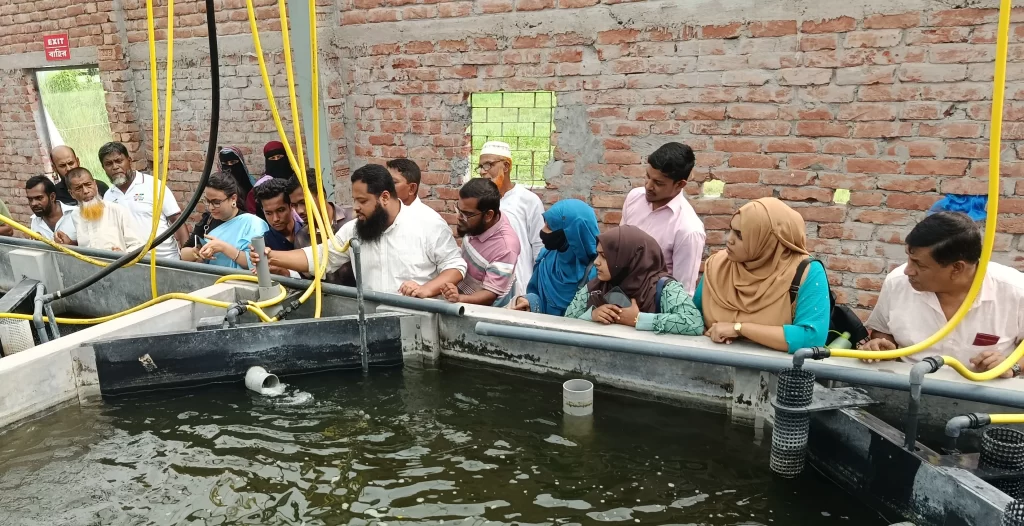
Within the FoodTechBangladesh partnership, the aim is to introduce improved technologies step by step through practical demonstration and the installation of systems at the different CoEs. In this way, Bangladeshi farmers are gradually exposed to innovative aquaculture systems and supported in adopting the right technology for their specific context.
The control within RAS systems translates into tangible advantages over conventional methods:
- Higher stocking densities, producing more fish per square metre of land.
- Year-round production cycles, independent of seasonal variation.
- Greatly reduced disease risk through a closed, bio-secure environment.
- Lower antibiotic use, as stable water quality minimises fish stress and illness.
- Minimal water discharge, making the system highly resource-efficient and more environmentally responsible.
At the CoE in Khulna and Mymensingh RAS outdoor and indoor systems are operational, with fish being produced for transport to local retailers. The CoE in Patuakhali is also developing a dedicated broodstock unit, enabling them to supply quality fingerlings to surrounding farming communities. This helps to strengthen the impact of FoodTechBangladesh on the local aquaculture value chain, improving the availability of high-quality fingerlings for farmers in the region.
In-Pond Raceway Systems (IPRS): intensifying production within existing ponds
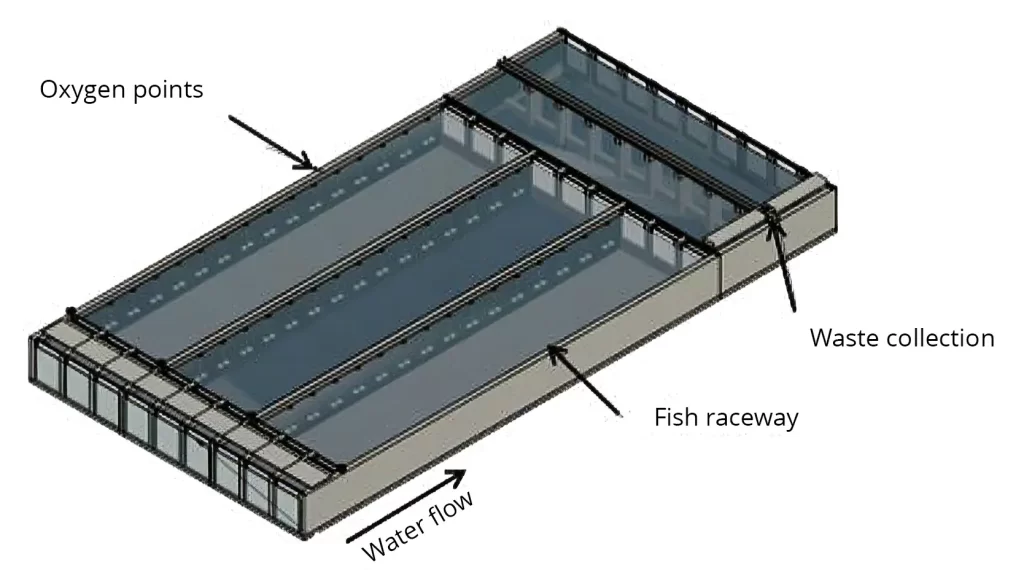
An In-Pond Raceway System (IPRS) is an innovative technology that improves efficiency, sustainability and productivity. It modernises traditional earthen ponds by installing raceways (water channels) where fish are raised in a controlled, continuously circulating water flow. This technology ensures consistent oxygenation, real-time waste removal and a clean environment for faster growth, healthier fish and higher yields. The technology is proving particularly relevant for the coastal and low-lying regions of Bangladesh, where land constraints and water salinity make conventional intensification difficult.
These raceways are defined water channels, for example 30 metres long, 5 metres wide and 2.5 metres deep; however, the size depends on the stocking density, fish species and purpose. Fish are stocked in these channels where continuous water circulation delivers oxygen and removes waste. The raceways occupy just 2–3% of the total pond surface, while the remaining 97–98% functions as a natural biological treatment zone, recirculating and purifying the water without chemical inputs. Waste collected at a central outlet can be repurposed as organic fertiliser, thus reusing the nutrients and reducing environmental impact.
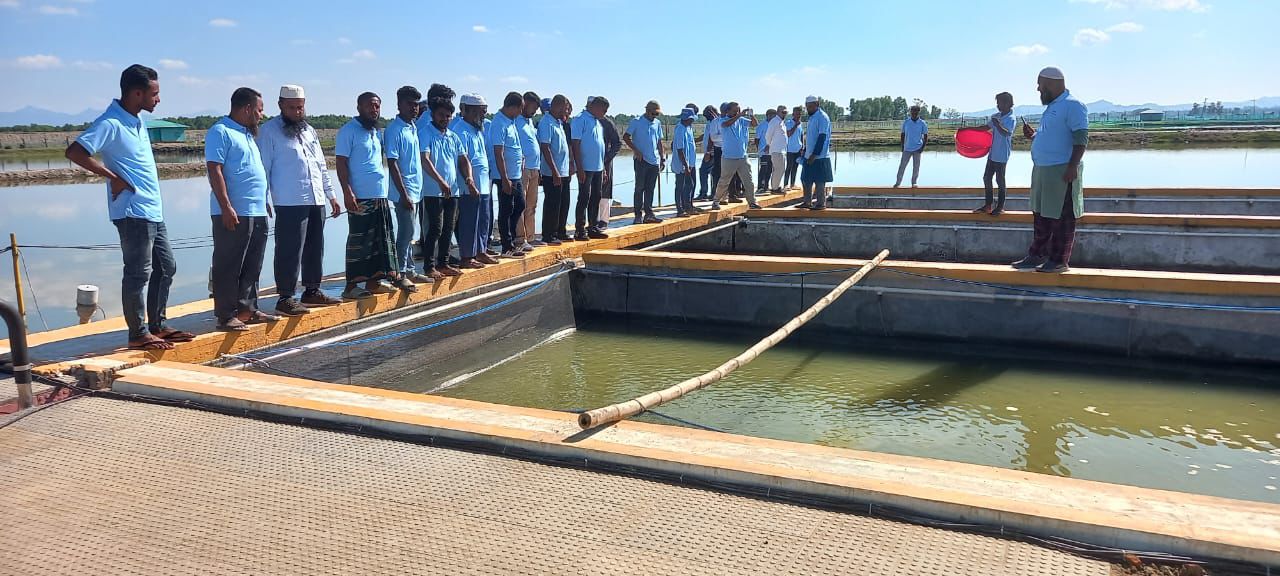
At the CoE in Cox’s Bazar, managed by our local partner FishTech, IPRS is now in operation. Notably, this facility is fully solar-powered too, demonstrating that high-tech intensification can go hand-in-hand with renewable energy goals.
The performance gains compared to traditional pond farming are substantial:
- 5 to 10 times higher fish production per pond, using the same land and water.
- Faster and more uniform fish growth, improving both yield and product quality.
- Reduced disease incidence through constant oxygenation and active waste management.
- Lower long-term operational costs, with strong returns on the initial investment.
Why this matters for Bangladesh
Fish is the primary source of animal protein for nearly 160 million people in Bangladesh. Meeting growing domestic demand, while also maintaining competitiveness in export markets, requires a significant improvement in productivity. Technologies, such as RAS and IPRS offer a path to achieve this without expanding land use or increasing pressure on water resources.
By introducing these technologies, the FoodTechBangladesh partnership is creating an impact. Farmers gain valuable and practical insights into how they can be applied through research, trials and demonstration activities. In parallel, train-the-trainer programmes and targeted outreach to sector stakeholders helps to transfer knowledge more broadly. This combined effort of technology, innovation and capacity building contributes to a stronger and more modern aquaculture value chain in Bangladesh.